Canadians come under rocket attack at NATO camp in Kabul
During the evening of September 11, a rocket was fired at Camp Warehouse, one of the Kabul ISAF bases. An hour or so later, an explosion was heard near Camp Julien, where Iain is stationed.
Following are some news articles about the attack.
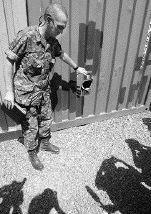
Major Guy Turpin shows the damage done in the rocket attack.
CREDIT: Tom Hanson, The Canadian Press
Canadians come under rocket attack at NATO camp in Kabul; no casualties
Posted on Rogers at 1:13am on September 12, 2003, EST.
KABUL (CP) - No one was hurt when a rocket landed within 20 metres of sleeping Canadian troops at NATO's main military base in the capital late Thursday, the second anniversary of the Sept. 11 attacks, authorities said.
The 1,950 Canadian troops in Kabul went on "the highest state of alert" for several hours after the night-time attack before returning to their normal state of readiness, said a spokesman for the Canadian contingent serving as part of the NATO-led International Security and Assistance Force, or ISAF. It was the first attack since Canadian troops arrived in August. In June, ISAF suffered its worst casualties when a suicide bomber driving an explosives-laden taxi killed four German peacekeepers and wounded 29 others.
Preliminary information indicated that two or three 120-mm rockets were fired at Camp Warehouse, the main ISAF base in Kabul, at 9:50 p.m. Thursday. About 300 Canadians are staying at that base, including Brig.-Gen. Peter Devlin, commander of the Kabul Multi-National Brigade.
Only one rocket landed inside the camp, hitting a shipping container in the northeast corner but causing no casualties, said Lt.-Col. Don Denne, commander of the Canadian battle group.
Engineers cordoned off the area and were investigating.
Sometime later, at around 11:05 p.m., an explosion occurred about 5,000 metres southeast of another base - Camp Julien, the main Canadian base accommodating the bulk of the Canadian battle group.
A dull thump could be heard, though it was impossible to tell from which direction it came. The camp is ringed by mountains.
Initial reports from battalion spokesmen put the impact at around 1,000 metres, but mechanized patrols determined it was much further away than that, Denne said. Missile-tracing radar reflected nothing, he added.
"All it was was an explosion," said the colonel. "This is a war-torn country, you hear explosions here all the time. It was probably not linked to anything that was a co-ordinated attack on ISAF camps."
Denne said he took defensive and offensive measures in response to the emergency, turning back incoming patrols and dispatching others to secure the area around the Canadian base, located about 30 kilometres south of Camp Warehouse.
Canadian artillery was on standby, Denne said.
"Everybody performed very well," he said. "There was a sense of urgency in the camp but no sense of panic."
Camp Warehouse is on the northern side of Kabul. Camp Julien is in the southwestern sector. The camps were plunged into darkness shortly after the explosions as a precaution against further attacks.
The incident came as tensions were high and security tightened on the second anniversary of the Sept. 11, 2001, terrorist attacks on the United States.
Kabul Police Chief Gen. Basir Salangi told The Associated Press that one rocket had struck the ISAF base and a second rocket landed in a field about 500 metres away and failed to explode.
The rocket attack came a day after Germany and the United States asked NATO to consider expanding the mandate of the 5,000-strong peacekeeping force beyond Kabul to help protect reconstruction teams outside the capital. Canada has said it is willing to support the idea.
Other than the devastating suicide attack in June, security in Kabul had been relatively good in recent months due to the presence of the peacekeeping force. The rest of Afghanistan, however, is ruled by warlords and beset by factional fighting.
And U.S.-led coalition forces - not part of ISAF - have been battling insurgents mainly to the east and south, while many of the outlying areas around Kabul had been left unattended for more than a year before the Canadians arrived.
Attacks against ISAF have been expected as the heat of the stifling Afghan summer eased.
Canadian Maj.-Gen. Andrew Leslie said in an interview Sunday that informants have daily warned ISAF of potential attacks. Arrests have been made and plots foiled, he said.
Reports of insurgents crossing the border from Pakistan are coming in every couple of days, although many of the reports are believed to be hoaxes, Leslie said. Even so, attacks and other incidents have been steadily creeping closer to Kabul in recent weeks.
STEPHEN THORNE
© The Canadian Press, 2003
Kabul rocket attack 'close call': ISAF
Chris Wattie
National Post
Saturday, September 13, 2003
CAMP WAREHOUSE, Afghanistan - Shrapnel from a rocket that slammed into the Canadian compound in the main camp for the International Security Assistance Force (ISAF) in Kabul narrowly missed sleeping soldiers and civilian workers, military spokesmen said yesterday.
"This would qualify as a close call," said Major Guy Turpin, spokesman for the Canadian contingent at the camp. "It was very close to the accommodation tents for our soldiers.
"It woke me up and I was five rows [of tents] down."
ISAF would confirm only that two rockets detonated, the first just inside Camp Warehouse, headquarters for the multi-national force's brigade of German, French and Canadian soldiers in northeast Kabul, and a second outside of Camp Julien, the main base for most of the 1,900 Canadians serving in ISAF, in the southwestern half of the capital.
But military sources said one more rocket was fired at Kabul International Airport, but exploded harmlessly in a field. There were no reports of serious injuries from the blasts.
Corporal Darrell Burke, 24, a reservist from Oshawa, had perhaps the narrowest escape of the more than 300 Canadians in the compound the rocket hit. He was on his way to his tent when the missile hit two bulk containers holding construction materials less than 10 metres away.
"I heard a whistle, then there were sparks from the explosion," he said yesterday, staring at the holes in the metal container wall where fragments of the exploded rocket had burst through. "I thought it was a drill ... there was no concussion, no fragments whistling past me -- just the sparks."
The flying metal perforated the canvas walls of two nearby tents where up to 15 military and civilian staff were sleeping and left large dents in the earth-filled "Hesco" barriers around them -- metre square boxes filled with gravel and earth to form protective walls around the Canadian compound and some of the structures inside.
Maj. Turpin said the rocket was launched from somewhere to the northeast of the camp and slammed into the top of one bulk container, punching holes through the metal walls and spraying fragments toward the Canadian tent lines. "There was no fire or subsequent explosions from the impact of the rocket," he said.
He could not say if the launch site had yet been found.
The suspected rocket attack on the Canadian camp, 35 kilometres to the south, still had not been confirmed yesterday. An explosion was heard between one and five kilometres away from Camp Julien about an hour after the attack on the ISAF base, but Canadian patrols were unable to locate the blast site.
"At this point, we are unable to confirm anything about that," said Captain Jay Janzen, a spokesman for the Canadian battlegroup.
Brigadier General Peter Devlin, the Canadian commander of the Kabul Multinational Brigade, was not available yesterday to comment on the attack. "He's at the airport greeting Canadians flying in today," Maj. Turpin said.
However, German Lieutenant General Gotz Gliemeroth, the overall commander of ISAF, said in a news release the rocket attacks would not deter the NATO-led force from doing its job. "We knew there would be risks involved in this mission," he said. "In fact, this incident reminds us of why we are here -- to help the Afghan transitional authority to increase the stability here in Kabul and the surrounding areas."
Rich Benoit, a civilian worker from Drayton Valley, Alta., was lying in his bed when the rocket struck and watched holes appear in the canvas over his head as shrapnel ripped through the material. "I didn't get scared until after," he said, staring at the small tears in the tent wall above his cot. "But I didn't get any sleep the rest of the night. Especially after seeing those holes open up."
Warrant Officer Ray Fonger, a military meteorologist from Hamilton, said the explosion lifted him out of his cot. "I'm just hoping this was just a one-time thing, just for Sept. 11th," he said.
© Copyright 2003 National Post